1. Manage My TA


Tasting Bangkok


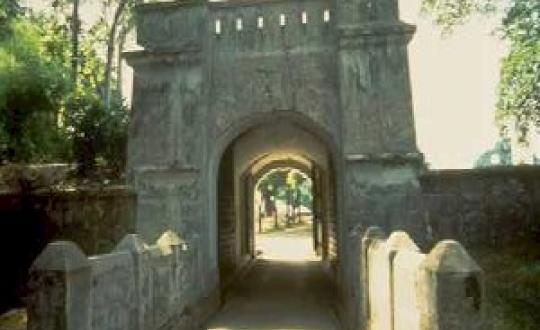
Pots and pans at the Thai House Entrance gate to the Thai House. Spirit House at the Thai House.

View Photos (7)

  • Image © 2004 Jacquelin Sonderling

My Asian friends all laugh at me, telling me that with my constant travels east I'm much more Asian than they are. That even extends to my love of Asian food - and the staples in my kitchen. Peek inside my pantry, and you'll find a healthy supply of shaoxing, fish sauce and a variety of chili pastes and sauces. I even have a jar of mudfish - left over from a Cambodian recipe that caught my attention.

Since I love Asian cooking, I wanted to really learn how to do it well -with the natural flair you'd have if you'd grown up with it. So, I decided, the best way to learn those nuances you just can't get from cookbooks was to go to the source.

It's not difficult to find cooking classes in Asia. I was tempted by signs advertising classes along Nathan Road in Hong Kong. A quick search of Taipei turned up a number of choices. But no country seems to offer a better selection - or better prices - than Bangkok. A little surfing on the internet - and I found what turned out the be the perfect place to learn the subtleties of Thai cooking - the Thai House!

The Thai House is about 40 minutes outside of Bangkok. Our trip there started not in a car but at the royal dock, where we climbed into a long boat. There were four of us: A Finnish woman, who was signed up for just the day. She didn't seem at all happy about our mode of transportation. Lauren and Bruce were a couple from Britain - he a banker, she a lawyer. They were spending the night and taking two days of classes. This was their first trip to Asia, and as soon as Lauren sat down in the boat, she whipped out her camera, ready for adventure. And then there was me -- scheduled to stay two night and take a full three days of lessons.

We left the dock and crossed the Chao Praya, disappearing into the maze of klongs on the south side of the river. We had a perfect December day - warm, but not too hot - and with no humidity. As we sped along, a cool breeze in our faces, I gazed at the houses that lined the klongs, trying to peer inside the doors and gates to see what life was like inside. Each house sported its own spirit house, some brightly painted in red and gold and white, some plain wood, worn by the weather.

About 15 or 20 minutes into our trip, we crossed under a highway overpass. To me, this summed up beautifully the mixture of past and present that makes up Bangkok's personality. New, modern cars were speeding overhead as the craziness of Bangkok dropped away behind us. Ahead - the quiet calm of the nearly empty klongs and life in many ways the same as it's been for centuries.

I was lulled into a wonderful state of relaxation by the hum of our boat's motor and the gentle sloshing of the water. After about half an hour, we can to a stop. At the "intersection," I spied a small local store. I wanted to stop and explore, but we had to keep to our schedule. That meant changing to a smaller boat. Our long boat was too large to navigate the increasingly smaller canals we were traveling to the Thai House.

Lauren, Bruce and I hopped easily from one boat to another. Our Finnish woman looked increasingly uncomfortable about our boat ride.

Another 15 minutes on the klongs, and we pulled up at a small dock. A black dog, looking like was equal parts Labrador and spaniel bounded up to meet us. We had arrived.

We followed a short walkway bounded by tropical foliage and orchids to a wooden gate. Through the gate, we found the back of the Thai House and the area outside the kitchen where our classes would be held. A slatted fence on one side held various pots and lids and woks, creating an abstract design. The small table that sat in the middle of the covered patio was set with cutting boards and knives for four. Our classroom awaited.

A small, energetic woman of undeterminable age greeted us. She was Pip Fargrajang, our teacher. She was almost ready to begin the lesson - but told us to first find our rooms and unpack. In about half an hour, she said, we should regroup and be ready to get down to the business of cooking.

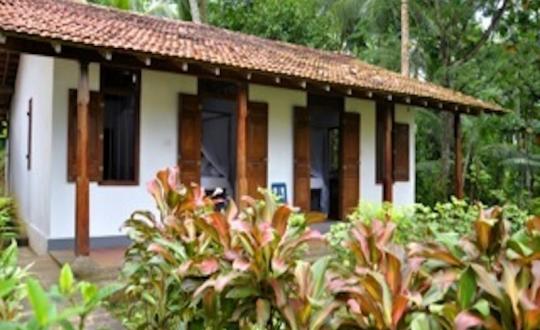
The Thai House is, as its name suggests, a traditional Thai-style house built of golden teakwood. Its style is what comes to mind when most foreigners think of Thailand - the winged rooftops and carved wooden roof tiles and stair banisters. The architecture actually is typical of what was popular in the Ayutthaya region in central Thailand about 150 years ago. Pip and her family built the house in 1990 with the idea of sharing their culture with travelers from around the world.

The first-floor is actually three separate buildings linked together. The largest building holds a good-sized room that doubles as both dining and common room. A small bookcase contained paperbacks - mostly in German. (I borrowed the single English-language book - and sent Pip four in exchange when I got back to Los Angeles.) A refrigerator was stocked with soft drinks and cold water. Another table held a thermos of hot water for coffee or tea. Outside was a covered patio where we could eat our breakfast and lunch and just relax.

As I climbed the stairs to the guest rooms, I could see the lush lawn stretching out behind the Thai House. Several puppies romped playfully in the long grass. To one side of the yard stood a large wooden spirit house that almost looked like a replica of the Thai house. Brightly colored garlands of yellow and magenta tropical flowers decorated the structure.

Upstairs, the guest rooms faced onto a central courtyard. Each block of rooms had a covered porch with a pair of rubber slip-on sandals sitting in front. It was quiet and peaceful, as if I'd been transported to not only another place, but another time.

I stepped inside my room and looked around. It was clean, neat and simply but nicely furnished: a bed - on the floor - a triangular Thai bolster that served as a back support when sitting, a dressing table with a mirror and a coat rack. White lacey curtains hung from the windows, and a ceiling fan whirred softly overhead. Screens on the windows meant I could keep them open at night without being joined by native creatures that tend to bite and suck blood.

My luggage was already waiting for me. Ready to get my unpacking out of the way, I reached for the door near the bed, assuming it was a closet. To my surprise - it connected to the room next door! Oh! Ok! This was a little smaller than I had expected! But - for three days - not a problem! I carefully re-locked the door.

Across the courtyard and around the corner, in a separate but still connected building, were the co-ed bath and toilet facilities. They were discretely away from the guest rooms but not far enough to constitute a trek. There were two toilets, two sinks and two showers - with cold water. Ok, then! This was not quite what I had bargained for! But I was game for an adventure! Besides - it was only three days.

We returned to our outdoor classroom and took our seats at the table. In front of each of us was a small wooden cutting board, a knife with a blade that was about six inches long and rounded on the end. Hmmm, I thought. That doesn't look like it will do much damage.

In the center of the table was a flat basket filled with the herbs, roots and vegetables that create Thai food's signature tastes: galangal, lemon grass, kaffir lime leaves, Thai eggplant - both the round green and white balls and the tiny pea-sized variety. Also on the plate were a colorful variety of chilies, mint, long beans and my least favorite, cilantro.

Pip began by handing us packets of the recipes we would be cooking. The Finnish woman got only what we were making that day. Lauren and Bruce got two day's worth. And I got the whole shebang. At the top of the page, Pip had written her name and ours In English and Thai. To me, the Thai alphabet is beautiful - but the words look more like a flowing line design than a language!

Pip started the lesson by talking about the various veggies in the center of the table, describing each one and passing it around so we could touch and taste. I have to admit, I was feeling a little superior, since I do a fair amount of Thai cooking at home and shop regularly in the well-stocked Asian markets we're fortunate to have in Southern California. Most of the things in front of us were things often found in my own fridge.

Pip next gave us a warning about the knives. They were very sharp, she told us, so we needed to be careful. She also warned us about how to cut on the board - she didn't want us to dull the knives.

Our first assignment was to slice all the goods on the platter.

"Very thin," Pip coached us. "Thin."

I immediately dived in, certain I was going to ace this one. I'll just wow everyone, I though confidently.

Lauren, Bruce and the Finnish woman bent studiously over their cutting boards, carefully and slowly slicing. I boldly drew my knife through a stalk of lemongrass.

"Too thick!" Pip immediately chastised me. "Too thick! Make them very thin!"

Ego deflated, I returned to my slicing, drawing my knife across the lemongrass. This time it met with Pip's approval.

"That's better," Pip smiled.

Next, we learned a little trick for slicing those deadly hot red and green Thai chilies that I love so much. Mouse poop chilies, they're called in Thailand. They're tiny - smaller than what I get in the markets at home. And they're much hotter than anything I'm used to.

Pip showed us how to hold then stem end of the chili with our fingers and then cut thin slices off lengthwise, leaving the stalk with the seeds in one piece. Our fingers never touched the chili, never had a chance to get the hot oils on our fingers. But we were left with thin, wispy strips of chili that would add a dash of color and a layer of flavor to our dishes.

Ah, tip number one that I've never seen in any of the cookbooks I've read! My cooking trip was beginning to pay off!

We moved on to the straw mushrooms. Real straw mushrooms - firm and smooth and almost white, not the slimy canned ones we're all used to. These were new to all of us. Pip showed us how to carefully shave a small amount off the bottom and cut the larger ones in halves and even quarters, if necessary.

Pip told us more about the first dish we would make - tom yam kung, a popular sour and spicy prawn soup. "Tom yam," Pip told us, "means a 'type of soup.' 'Tom' means 'boiling' and 'yam' means a mix of three tastes: salty, spicy and hot."

Pip continued our brief language lesson - teaching us that 'mu' means 'pork.' 'Kung' is 'prawn,' 'pla' is fish, and so on. And then Pip began to impart the real tidbits of cooking information that I had traveled 8,000 miles to learn - those little techniques you can only learn from working in the kitchen with someone who knows. Pip told us that if we're only making a small amount of Tom Yam Kung, we don't need to add chicken stock. The shrimp in the soup will add enough flavor to the broth. I was scribbling so many notes that I barely had time to watch Pip work.

We moved on to Lap Mu, a savory chopped pork salad, and Phat Thai Sai Khai, or everyone's favorite -- Pad Thai.

All afternoon, we diligently sliced and chopped and stir-fried and scribbled notes. Pip constantly reminded us we must keep tasting our food, adjusting the seasonings - a little more fish sauce, a little more salt. Since the cooking food was a work-in-progress, Pip kept small containers of various condiments within handy reach of her wok, ready to adjust at a moment's notice.

Finally, after a long afternoon over a hot cutting board and hotter wok, it was time for the best part -- eating our work! We adjourned to the patio outside the common room where we relaxed, sipping coffee and tea while we chatted about our lesson and got to know each other. Pip's staff soon began serving us our meal. Absolutely delicious! We were definitely on our way to becoming if not experts, then at least competent enough to impress our friends back home!

Day Two started with a trip to the local market. The Finnish Woman had left the previous afternoon, so it was now just the three of us. I've been to many local markets - I love them and always make it a point to wander through as many as I can. But this was a first for Lauren and Bruce.

No romantic boat rides for us on this trip! We piled into one of the Thai House's mini-vans and jumped on the highway, getting a look at small city life outside of Bangkok. We passed car dealerships that sat right next to shops selling spirit houses. The houses were displayed at the edge of the highway - perched on solid pillars and painted in the familiar bright blues and reds and yellows. We left the highway and turned down some side streets, into a slightly more residential area. Finally, in what must have been the center of town, we turned once more. At the end of the street was a temple. In the middle of the block was our market.

This was a small market, covering only two or three blocks. It was only moderately busy, maybe because this was a Thursday morning and people were already at work. As familiar as I am with markets, though, I immediately discovered things that were entirely new to me.

The first thing I spied were the low wooden tables of greens - scallions and leafy greens and herbs such as mint. But I also saw baskets that were full of bundles of lemongrass, galangal and cilantro banded together. I realized they were ready-to-go "packages" of ingredients to make many traditional Thai dishes - like the tom yam kung we had made the day before. How wonderful! It was a kind of fast-food seasoning - just add some chicken stock, shrimp and chili - heat, stir and serve!

There were also stalls that sold curry paste - huge restaurant-style silver mixing bowls that were easily two feet in diameter. The bowls were piled at least another foot high with homemade curry pastes - mounds of red and yellow and green. I've never seen so much curry paste in one place before! Some of the bowls were almost empty. Another looked like Half Dome at Yosemite. And yet another looked as if it had hardly been touched. Or maybe what I saw was already a second or third bowl of that one! The woman who ran the stall scooped up some curry paste, plopped it into a plastic bag, weighed it - and handed it over to the waiting customers.

We continued to wander through the market. I saw foreign-looking roots that seemed like something from another planet. I had no idea what these were! There were bags of brightly colored chilies - not only the red and green we were using the previous day, but orange, pale green and a deep, dark forest green.

There were old women sitting on low stools, chewing on betel nuts as they picked over some type of bean. Their teeth - what's left of them! - were stained black from the betel juice. They willingly posed for photographs - but wouldn't smile.

I saw baskets of eggs and various squashes. There was a peanut vendor who carried two flat baskets of his wares on a pole across his shoulders. He took a break, resting on his haunches, watching the traffic in the market.

Then there were the fried - rats. Or rodents of some sort. They were whole and fried and honestly -- quite disgusting. But they didn't seem to bother the dog that slept below the table where they were laid out on grease-soaked newspaper. It made me once again consider becoming a vegetarian.

Lauren and Bruce seemed most fascinated by the fruit. Living in Southern California, I forget that there are parts of the world that can't get the beautiful produce we have - especially in the middle of winter. They bought a bright pink dragon fruit and several small Thai apples.

After an hour or so, it was time to get back to our classroom. On the menu today - curry. Curried chicken. Beef curried in sweet peanut sauce. And we were also going to make another soup - Kai Tom Kah - or Chicken in coconut milk soup. Oh yes - there was one more thing. We were going to make our own curry paste!

Even though many Thai people prefer to buy their curry paste from the market (either fresh or - gasp! - canned!), Pip was going to make sure we didn't leave without at least knowing how it was done. Besides a mixture of dried chili, shallots, garlic, galangal, lemongrass, coriander root, kaffir leaves, shrimp paste, this job called for a stone mortar and pestle.

Step by step, Pip walked us through the fine art of curry paste-making. First, of course, we sliced whatever needed slicing. By now, we were all expert, including a much more modest me. After slicing, we gathered around our burner while Pip stir fried the dry ingredients. Next, into the mortar went some lime peel, galangal and a little salt to help break down the ingredients. We moved back to our table so Pip could show us how to drop the pestle on the mixture rather than actually pounding it. We each took a couple of test pounds at the paste to get the feel of the technique. But it was Bruce who had the honor of actually pounding the ingredients into paste. Lauren and I watched as Bruce worked up quite a sweat. I don't know about Lauren - but I was quite happy to let Bruce have curry duty!

Pip continued to toss ingredients into the mortar, and Bruce kept pounding away. To my amazement, it didn't take long for Bruce to turn the mixture into a bright red paste. Now, I'm a big fan of making everything from scratch. But as good as the fresh curry paste was - I think I can live with the canned stuff at home!

As we made the Pha Naeng Neua, or Beef Curried in Sweet Peanut Sauce, I picked up another of those little tips that I had come here to learn. Pip showed us how to cook the curry paste - mix, then stop and let it get shiny. When you see the sheen, she instructed us, add a little more coconut milk. Repeating the process three times brings out the curry flavor. But we also quickly got another admonition from Pip - never rap the spatula on the side of the wok to remove food from it. You might crack the wok! Instead, tap it on your wrist.

We also got a lesson in making our own coconut milk. I'd read out how to do this in books - but to see it and actually try it was a real experience!

Thais use a very sharp shredder to get the coconut meat out of the shell. It's a small round piece of metal, just a few inches in diameter, with teeth about three quarters of the way around the metal circle. It looks simple - but it's potentially quite lethal! The shredder is mounted on the end of a very low bench. You sit on the bench, just a few inches off the ground, and, working with half a coconut at a time, you scrape the inside on the shredder. Three scrapes, then turn slightly. Three more scrapes, turn again - and so on, until all the coconut meat was shredded. We each took a turn at shredding the coconut. Pip's father had made her bench - it had a little tail on the back, making it look like a little lamb. It was also no more than four inches off the ground.

I eased myself down on the bench, grabbed the coconut and started shredding. It wasn't as difficult as it looked, and I thought I was keeping up a pretty good pace - until Pip took over. She could shred an entire coconut in less than five minutes! Ok - I'm good with canned coconut milk!

Once we'd finished all our dishes, we again adjourned to the patio where we gorged ourselves on our day's work. It was more than satisfactory!

This being Lauren and Bruce's last day, they made their exit shortly after lunch, leaving me on my own. But that didn't mean the Thai House was empty. Taking cooking classes is not a prerequisite for staying there, and in fact, the Thai House offers its accommodations as a quiet alternative to the chaos of Bangkok. That night, though, there was only one other guest, a young Frenchman, who joined me for dinner.

At one time, I could use my French to get directions and even use public pay phones. I could even hold my own in a simple French conversation. But let's face it - it's been awhile! Fortunately, between his rough English and my rougher French, we were able to carry on a simple dinner conversation.

Day Three dawned with me on my own. Now, the pressure was on! I had to be on my toes! No egos allowed here! It was do or die time!

I sat down at the table to prepare the herbs and vegetables for our day's cooking. Carefully, I drew my knife across the straw mushrooms and ginger for the stir-fried chicken with ginger. Deftly I sliced through the beans for the stir-fried pork with yard-long beans. With practiced strokes, I sliced the chilies, leaving the center with the seeds in one piece. Pip nodded in approval. I sighed with relief.

Now, it was just me at the single burner. Me, hoping my wok technique would pass muster.

We moved quickly through the various dishes, and again, I learned a trick. Pip showed me how to mix a little bit of water in with the pork balls for the clear soup we were making. Add a little water and fold it into the meat with the back of a soup spoon until it's all absorbed. Add a little more, mix some more until it has the proper consistency - smooth but not watery. When these meatballs were cooked, they were so incredibly smooth, like velvet on your tongue. I vowed I would never make meatballs any other way.

And then - it was time for Pip's daughter to take over for a lesson in vegetable and fruit carving!

My heart was beating. I hadn't realized I'd be carving. This was entirely new to me. The cooking - I was on solid ground. But the carving? I'm sure sweat started forming on my brow.

She handed me a knife with a plastic handle and very small but extremely sharp blade. We started with something simple - fluting the edges of pineapple. Although my cuts weren't perfectly even, I did a passable job. And gained a little confidence. Even though it was rough, I could see what it was supposed to look like.

We moved on to something more difficult - onion cups and then chili flowers. Still even though my cuts were far from perfect - some deeper than others - I could see the results. With a little practice, I'd be able to impress my friends!

I tried to scribble notes and draw pictures between carvings. This was turning out to be too much fun!

Next, we took on tomato cups, filling them with flowers made from tomato peel. I'd never peeled a tomato before, so learning how to do that was step one for me. I felt as if I was all thumbs. But somehow, I managed to peel that pesky tomato and make a presentable rose!

Then the lesson really got difficult - carving pieces of cucumber to make flowers and other designs. These were like carving relief pictures in the chunks of cucumbers. At first, I couldn't quite manage it. Then, I started to get the hang of it, learning to imagine the finished picture in my head, then cutting out little pieces to turn the cucumber into a leaf or flower - or just a decorative piece. This was really getting fun!

Finally, the most difficult of all - at least for me. The Carrots. I found myself carving the carrot into tiny petals, turning the whole vegetable into a flower. Whew! This was really hard! It was exacting work, taking all my concentration. But finally - yes! A carrot flower! I can't say I mastered the techniques - but I definitely got a taste of it.

Too soon, it was time for my mini-van ride back to Bangkok. I said good-bye to Pip and her family, promising to let her know how I did on my own back in Los Angeles. But before my trip home, I still had a few days left in Bangkok - time enough to head for my favorite supermarket and stock up on vegetable carving tools. My friends and family have no idea what's in store for them!

* * *

For information on the Thai House: www.thaihouse.co.th

* * * * *

Published on 3/10/05

Sponsor links

Comments [0]

Add Comment

You might also be interested in

Himalayas, Leh

Southern-East Asia and Central Asia experience in photographs

Olga Mo - peremeny [55]

RADIOTRAVEL is the big long-distance and long-term journey. We travel in countries of Southern-East Asia and Central Asia. Aim of this project - creation of online blog-book. During the journey we...

Destinations: Karnataka | Himalayas | Ko Tao | Mumbai | Hoi An | Guilin | Himachal Pradesh | Kathmandu | Hangzhou | Beijing | Bangkok | Kerala | Ninh Binh | Nepal | Hanoi | Vietnam | New Delhi | Varanasi | India | Ladakh | Zhejiang | China | Port Blair | Thailand | Kochi(India) | Goa
Topics: Travel | People | Photography | Traditions | Food
This fruit seller had a business on her boat

The Venice of Asia

MaryLou Driedger - marylou [2,422]

I could have been in Venice. Bangkok is a city of canals and waterways.

Destinations: Thailand | Bangkok
Topics: Travel | Adventure | Animals | 20th Century History | Traditions | Ecotourism | Culture | Food | Economy | People | Religion | Fashion | Agriculture | Shopping | Nature | Architecture
Tone Deaf in Bangkok

Nausea and Desire

Tone Deaf in Bangkok - tonedeafinbangkok [170]

For Janet Brown, getting used to the smell of Bangkok---its "refuse, canal water, jasmine, heated garlic, freshly squeezed oranges, and bus exhaust fumes"---was one thing. Getting used to the stink of durian fruit was quite another ...

Destinations: Thailand | Bangkok
Topics: Food | Literature
More Stories of Interest
ThingsAsian

ThingsAsian is an Asia travel website with maps, stories, photos and travel tips contributed by a worldwide community.

©1994-2008 Global Directions, Inc. All Rights Reserved. Contact webmaster@thingsasian.com

Web Design by Dayspring