Thai Markets - The Real Thing
A scene from the floating markets near Lak Ka in Samut Sakhon, to the south of Bangkok. |
|
At times, Thailand seems like one giant market place: "Amazing sales" promotions for jewelry, fashion clothes, and antiques in up-market stores; counterfeit brands at the night markets of Bangkok's Patpong Road; tee-shirts and souvenirs at the floating market of Damnoen Saduak.
As you experience each, travel cliches come easily to mind.
But most tourists see only what they are shown... while out of sight, locals simply go about their business: buying and selling, shopping and swapping, bartering and bargaining, exchanging goods and gossip, trading and talking.
Nothing counterfeit here. Thai markets -- the real thing. But you have to seek them out.
On any single day in the ancient capital of Ayutthaya, for example, hordes of visitors will be swarming over the red-brick and carved grey stone of the centuries-old ruins of temples and palaces, pre-dating the founding of Bangkok. If they think shopping, they will see souvenir stalls between the triple chedi spires of Wat Phra Si Sanphet and a chapel housing a large bronze Buddha. Or they will be steered towards the Royal Folk Arts and Crafts Centre, fostering traditional skills.
But locals shop at the other end of town, in alleys and narrow streets jammed with stalls and haphazard displays, sheltered under makeshift awnings and sun umbrellas. This is the Central Market, where traders and their customers arrive on foot, by bike, on motorcycle taxis, in cycle rickshaws, garish tuk-tuks and smoky mini-buses.
It's a busy, cliche-ridden experience: colorful, vibrant and exotic, with shallow circular baskets displaying fresh fruits and vegetables in patterned shades of greens, yellows and reds. And everywhere cheery, bright laughing faces.
Banter flows back and forth between trader and potential buyer, and between competing stall holders. It reaches a different level when they see me and my camera, and, without understanding the language, I become part of the interaction.
By now I am in a small "wet" section, watching a woman gutting large frogs. She displays one to me, held delicately under its "armpits" by thumbs and little finger, then flips it into her palm, white underbelly exposed. She draws a cleaver down its body, and extracts entrails with her thumb, then picks up another living frog from a tied bundle in a bucket and repeats the process.
Gutted frogs are put on display for sale, the intestines flipped into a white plastic container (I suspect to be used for something), and the work area is stained red with blood. My mind will not let me focus the camera properly.
Stepping backwards, I am aware of movement near my feet. This big blue basin is wrigglingly alive, with what I first think are snakes, but which on closer inspection are bright, banded eels. Adjacent, another basin is full of small squirmy things that I just cannot identify.
By my elbow, another stall holder is at work. Fresh fish flop, and then, chop!, are beheaded and gutted into a colorful display of red-pink flesh and black skin. But not too many at one time, for customers here obviously like their food very fresh.
Yes, some local markets do have a downside for visitors.
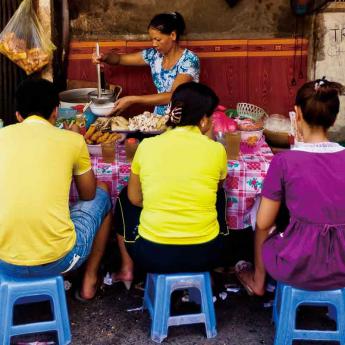
Nevertheless, I feel I must try the ritual of the local coffee stall. A glass is cleaned especially well for me, the delicate-stomached foreigner. Two large spoonfuls of condensed milk are scooped into it, followed by a generous dash of evaporated milk. The coffee is drained and strained and filtered through a stained piece of muslin that looks like a stocking top.
You stir to taste, only a little if you like your coffee black and strong, a little more if you like it white, or digging deep into the condensed milk to make it white and sweet.
Extremely sweet. And very drinkable. Just the thing to complement a doughnut type bun, deep fried in bubbling yellow oil in a wok, generously offered by a smiling young woman.
They were equally generous, the locals, a couple of days later in another tourist-free market within the same daily striking distance of Bangkok, where I was practically forced to nibble on sickly-sweet coconut candy and sample tasty tiny bananas, no more than six centimetres in length.
This was a traditional floating market, but not the one at Damnoen Saduak, which over the years has become more and more commercialized for the tourist dollar, a decreasing proportion of its area devoted to fruit and vegetables and conversely greater space for outsiders, and where 50 coaches might be parked to whisk passengers on to the next stop on the tour, the Rose Garden show.
We were at the market of Lak Ka in Samut Sakhon, in the same general area, that low-lying country to the south of Bangkok, criss-crossed by small canals called "klongs".
And, as regular tourists normally do on coach tours, we had arrived at the market place by long-tailed boat, that strange Thai invention -- a long thin boat to fit the narrow klongs, powered by a huge automotive engine, which counter-balances an amazingly long rudder shaft by which the boatman steers.
I've got news for the designers of this type of boat. It is not perfect. On long straight stretches it throws up a wash of such strength that residents of houses on the bank have to sling their own smaller vessels out of the water to avoid damage caused by passing traffic. And drivers have to cut to idle when anything comes the other way to avoid creating a clash of waves that would flip the Poseidon.
Also, the helmsman is so far back from the sharp bow that he cannot see round corners, and the boat itself is so long, that when he comes to canal cross-roads (no traffic lights or give-way signs here), he has to shunt back and forth, making several separate manoeuvres to negotiate the junction.
Perhaps this is why the locals are in a different type of vessel, smaller, more like the type of punt you might see on an English river such as the Cam or the Avon, poling themselves through the shallow water in increasing numbers as we approach the market place.
Not only are these klongs shallow, they are tidal, so that some market days are based upon the waxing and the waning of the moon and how that influences the height of tides.
Lak Ka market place is simply a wider section of a klong, on one side of which has been constructed a small concrete wharf, so that you can shop from either water or land.
Perhaps fifty boats crowd this small area, not jostling for position, nor shouting their wares, but gently drifting among each other in a constantly changing pattern, exchanging news and examining each others' merchandise. The boats are laden to varying degrees with farm produce -- one might be overflowing with green un-husked coconuts, another half full of large white marrows, a third with only a small wicker basket of onions.
With their men no doubt tending fields, women are in charge. The fashion is peasant plain, single color long-sleeved shirt, usually blue, loose wrap-around sarong-type dress, and lamp-shade hat.
From time to time a purchase is made. Money may change hands, or a barter deal be struck, half a kilo of this for a bagful of that. Plenty of time to share a snack, enjoy some coconut ice cream.
There is a serenity. No hustle and bustle. And not a copy watch nor a fake leather handbag to be seen. A real traditional Thai market.
Published on 3/21/01

[6 ratings]