Memories of a Train Ride Through Kyushu
Japan is a nation of trains. And when you say the words "train" and "Japan" in the same sentence, they instantly conjure comical images in the minds of most listeners. The filter of the media shows us sleek, ultra-modern trains traveling at 300 kilometers per hour, and stations packed with endless waves of rush hour commuters. And, of course, there are the pathetically hilarious video snippets of uniformed, white-gloved "pushers" appearing from nowhere to cram passengers into already jam-packed cars.
During the time that I spent in Japan, the trains I rode in all parts of the country not only carried me from destination to destination, but also helped me form opinions of Japan and the Japanese people. Some of those impressions were good, some not so. A trip to Kyushu, Japan's large southern island, gave me a new perspective on not only Japanese trains but on Japan itself.
In the week leading up to my departure, my Japanese friends seemed quite surprised when I mentioned my destination. As if I was ordering red wine with fish, they all gave me the same look and asked: "Why do you want to go to Kyushu?" Everyone seemed to be pushing me to go north from Kobe towards Tokyo or Hokkaido. Truth be told, neither place had any grip on my imagination. I'd been to Tokyo and wasn't impressed with the drab urban sprawl. Hokkaido ... well, I don't know why I didn't want to venture there. Chalk it up to a lack of desire.
Kyushu, on the other hand, was last part of Japan I was interested in visiting. This trip gave me the chance to be a wide-eyed tourist and not the blasé traveler I'd morphed into. Among my goals were to experience a couple of the famous hot springs, to get close to a live volcano, and to make the obligatory pilgrimage to Nagasaki.
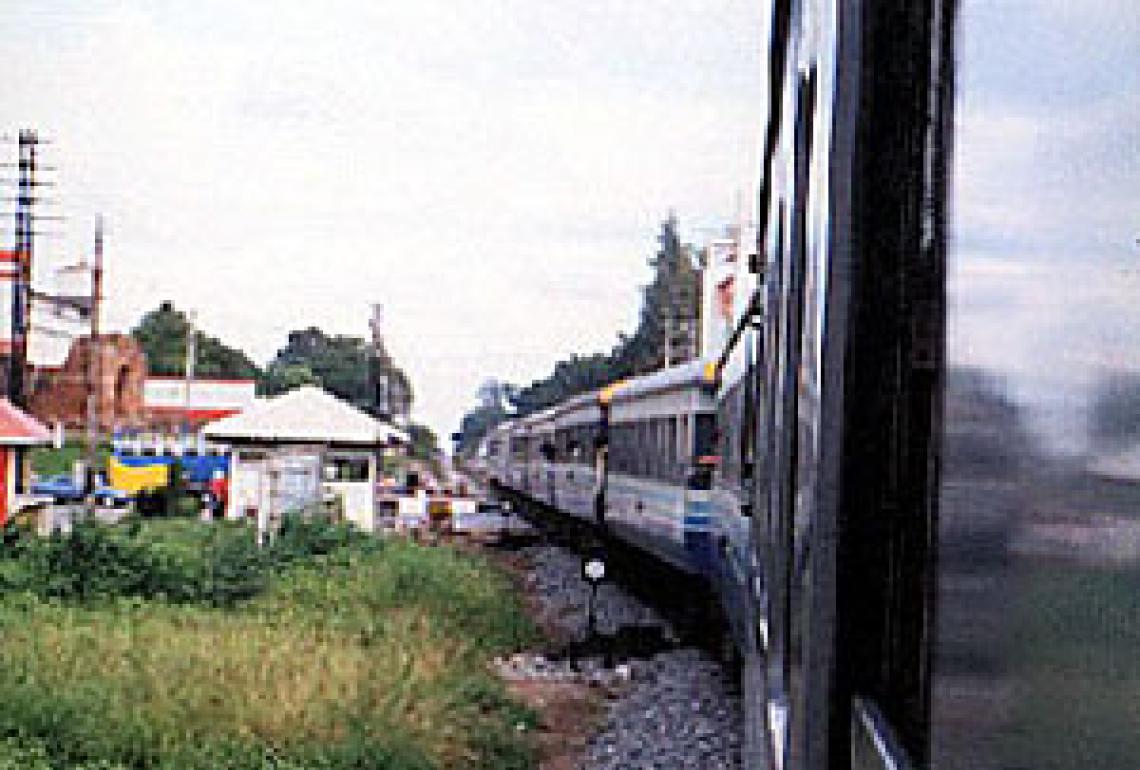
To do the latter, I crossed the inlet of the Ariake Sea aboard a ferry and landed at Shimabara, the starting point for my journey to Nagasaki. I trudged a few hundred metres from the ferry dock to the nearby depot, bought my ticket, and waited at a weather-beaten Japan Railway (JR) station that was typical of the ones I'd encounter in Kyushu.
The half-dozen cars that rolled in weren't like any I was used to in Japan. Its cars were a faded white, with a liberal coating of grime just above the wheels. The cars weren?t quite dilapidated, just old and growing increasingly rickety with each passing day. I muttered "Kyushu: the place old JR trains go to die."
The cars came to a groaning stop and I waited for the doors to open with their familiar pneumatic hiss. Seconds passed and nothing happened. I stepped back, thinking there was a problem. When I glanced one car down the track I noticed a man pulling a handle to open his door. When in Rome ... I thought and reached out.
It was upon taking a seat that I realized how old and well-used this train was. The seats were like that old sofa in your parents' rec room. Faded and threadbare, with that distinctive sponginess that comes from thousands of behinds straining springs beyond their limits. The seats weren't uncomfortable. In fact, they were perfect for the long journey ahead.
Sitting in that train was like sitting in a Canadian public school classroom in the middle of winter - it was heated to the limits of human endurance. For what seemed like the millionth time, I shook my head at how the Japanese warmed and cooled their spaces. To escape the scorching heat and humidity of summer, air conditioning is cranked to 10; just about every building or rail car you enter feels like a meat locker. To keep the winter cold at bay, heating systems are set at near scorching levels. It's almost as if the Japanese are trying to create the conditions of summer indoors. The car was so hot that perspiration soon began to glaze my forehead and beads of sweat snaked their way down my back. As I slipped out of my leather jacket, I tried unsuccessfully to peer out of the heavily misted windows at the passing landscape.
An avid rail traveler once told me that every train has a distinct personality. In Europe, this is taken to an extreme in which many trains are named like ships. While traveling from Brussels to Dusseldorf, I rode a German train dubbed the Alexander von Humboldt. In Japan, the personality of a train is apparent even to the casual visitor. The famous Shinkansen (bullet trains) exuded an unmistakable sleek, moneyed power. The inter-city trains and subways that I rode to and from my teaching job were plain, prompt, and utilitarian. Nevertheless, both projected that certain cold Japanese impersonality that make an outsider feel like an outsider.
The old trains in Kyushu, though, had their own unique personalities that reflected the personalities of their riders.
After a few station stops, the train was noticeably filling up. Not quite the sushi zume ("packed like sushi") I was used to during rush hour, but close quarters nonetheless. To my right, I noticed an elderly woman holding a cluster of shopping bags in one hand; the other held a passenger support in a knuckle-whitening death grip. I half rose out of my seat, caught her eye and said Obaasan, seki o yuzurimashoo ("Ma'am, please take my seat").
What struck me is that the woman wasn't surprised that I could speak Japanese. And, unlike the obachan in Osaka and Kobe, she didn't pretend she couldn't understand me or refuse the offer. What she did was sit down and start talking to me. Not the usual questions foreigners living in Japan are bombarded with: "Where are you from? How long have you been in Japan? Can you eat Japanese food?" Instead she began complaining about the weather. Heavy April rains had been lashing the area for several days.
"I really don't like the damp and cold," she said. Ï can feel it in my bones.
I nodded in agreement and said "My knee always aches in weather like this."
The old woman seemed surprised. "But you're so young. What could be wrong with you?"
I told her about the knee surgeries I'd undergone over the seven years earlier and some of the minor aches and pains that having no cartilage in the joint caused me.
We chatted about various inconsequential things for another three or four stops, then she got up and thanked me - for the seat or the conversation, I'm still not sure - and got off.
The train remained stationary for several minutes. An open door gave me the twin opportunities of cooling down a bit in the heavy breeze and having a look at the station. Only, it would be a stretch to have called this a station. Beyond the barriers blocking traffic with their flashing lights and annoying klaxon, there were no signs that I associated with a train stop. No ticket machines, no platform, no covered waiting area for passengers. The station house itself was nothing more than a glassed-in shed measuring about 4 meters by 3 meters standing on the topmost edge of a beach. When the train stopped, the uniformed stationmaster and his junior popped out and either exchanged money for tickets or checked a passenger's train pass.
I smiled at the rustic simplicity that hadn't yet been subsumed by Japan's lust for modernization. In the microcosm of the Japan I was used to, this place bordered on the absurd. But I could see how this might be a choice posting for a railway employee.
Beyond the station was one of the nicest expanses of beach I'd seen in the country. Wide, flat, smooth and empty. The sands looked like they hadn't been trod upon in aeons. The sea rolled with an understated grace and, every so often, waves dynamically assaulted a small breakwater. The shore hadn't yet been peppered with the concrete tetrapods as had other sections of Japanese coastline. The tetrapods, if you've never seen them, are gray monstrosities that the Japanese authorities put into place ostensibly to protect beaches and seashores. All they do is deface the natural beauty.
Here, the dividing line between the beach and the nearby town was the railway itself. The line bisected nature and civilization, almost like a line on a surveyor's map. While a definite schism existed, nature was tantalizingly nearby. All you needed to do was take step across the tracks.
Several stops down the line, a group of five high school students boarded the train. Upon seeing their blue uniforms and shaved skulls, my first was to brace for the talk pointed in my direction. But it never came. The boys just took up a position in the center of the car and started animatedly talking about their school's upcoming sports day. For the first time since coming to Japan, I didn't feel like a thousand eyes were focused on me and my every move. And it was not because of the number of passengers - for an early afternoon, there were surprisingly few riders.
In Kobe, and in the other parts of Japan I'd visited, I was accustomed to being on the receiving end of stares and of pointing, of the shrieks of gaijin (foreigner) and the comments about my long hair. These were annoying at first, but I learned to ignore them by either burying myself in a book or cranking the volume on my Walkman up a notch or three. Throughout my trip to Kyushu, no one seemed to notice me. No comments or gestures in my direction. And, blessedly, no one sidling up and speaking to me in English - or in many cases what they thought was English. I wasn't drawing any attention whatsoever. Not from the teenagers getting on and off this train, not from the elderly manager of the inn I had stayed at a couple of nights before, not even from young children. Earlier that week in the city of Kumamoto, a local had even asked me for directions!
To this day, I really don't know why. Perhaps it had to do with history. Nagasaki, Kyushu's largest port, was the first place in Japan to receive Western traders. They were familiar with foreigners and thought nothing of them. Perhaps it was because the denizens of this part of Japan were naturally more laid back than their stuffy northern cousins. The inhabitants of Kyushu reminded me of people in Atlantic Canada: friendly, easy-going and not really giving a damn about who you were or where you were from. It was a refreshing change to the Japan I thought I knew.
***
The ride from Shimabara to Nagasaki isn't a non-stop trip. You have to change trains at Isahaya. Like the train I'd just gotten off, the station at Isahaya was old and run down. But it possessed a certain character that made you look beyond the crumbling masonry and the grimy analog clocks hanging from the ceiling. The Nagasaki-bound train was of a slightly newer vintage than the one I'd just ridden, but it too was showing the signs of age and wear. The cars were just as hot and stuffy, but there were fewer passengers and I could get a clear view of the landscape in the inexorably encroaching night. Along the way, a long unseen sight grabbed my attention and wouldn't let go. It was trees. A lot of trees.
Modern Japan is, in many ways, at war with nature. In his book Lost Japan, Alex Kerr writes: "It is said that of Japan's thirty thousand rivers and streams, only three remain undammed, and even these have had their streambeds and banks encased in concrete." Trees and forest have suffered as well, with centuries-old growth leveled in the name of modernization. But if someone tells you that Japan doesn't have any large tracts of trees, that person is either lying or doesn't know what they're talking about. While not as impressive as the forests of Ontario, British Columbia, or the Pacific Northwest, there's something almost otherworldly about a stand of trees in Japan.
Not that I wasn't used to greenery of the Japanese variety. I lived in town called Yamanomachi, situated in a valley in the mountains surrounding Kobe. Foliage abounded there, and in spring the scent of cherry blossoms filled my apartment. But no matter where I looked in Yamanomachi, I could always see some evidence of humans. A streetlight, a building, scraps of litter. Here the situation was different. Occasionally a light peered out from behind the trees, but the only tangible evidence of civilization was the stretch of track I was on and the stations that interrupted them. I had an uncontrollable urge to open a window and breathe in the smell of the pines and damp earth, to reach out and pull a few leaves off a nearby tree. Unfortunately, I'd been living in Japan too long. Courtesy for my fellow passengers checked this desire to get closer to nature.
All too soon, the train arrived at Nagasaki station. At that point, I really didn't want to get off. My childish wish was to stay aboard that train, and other trains like it, until the end of my vacation. I wanted nothing more than to see each station stop, stare into the landscape, and chat with the other passengers. Most of all, I didn't want to worry about where I was going and where I'd been.
I reluctantly hauled myself off the train. As I walked out of the station to find a place to eat and stay the night, I reflected on the journey up until now. I'd seen facets of Japan that I never really expected to see. More importantly, I'd seen a side of the Japanese people I never thought existed. I learned that we're really not that different after all.
Near the station's entrance, a clock caught my eye. A thought struck me and I smiled a silly little smile: no matter how old Japanese trains are, no matter how run down their stations, there was one constant: they're always on time.
* * * * *
Published on 8/30/05

[3 ratings]