1. Manage My TA


The Mysterious Stones of Old Hue

The obstacle stone of An Cuu.

The obstacle stone of An Cuu.

The obstacle stone of An Cuu. The remains of the stone statue that emerged from the ground in Dien Thieu Sinh at Co Bun. Behind, a figure of the Holy Mother renders homage to the stone. Mrs. Bi's stone (the orange one) between An Lai and Van Quat Thuong.

View Photos (5)

  • Image © 2000 Steven Boswell

Look carefully around Hue and you will frequently see thin, scarlet rods, the remains of burned out incense sticks. They are particularly numerous on the grounds of the central hospital--remembrances for those who entered but did not leave. The sticks also protrude from cracks in walls, emerge from the bark of tree trunks, rise from the ground below bushes and trees and fill bowls on countless altars. Incense is burned to honor the dead, appease wandering souls, venerate the earth god and show respect to the other deities, spirits and genies of the land of Hue.

Hue is indeed a land of divinities, honored in the city's temples and shrines, worshiped on small altars placed on a pole in the garden, at the foot of a wall or high up under an overhanging roof. These spirits are venerated for religious purposes while others are adored not just for their divine elements but also for their magical properties. Among these are spirit stones which may grow, grant favors or cause harm to those who dishonor them, even those who do so inadvertently by standing or sitting on them (and woe to anyone who urinates on them). Other stones of Hue include obstacle stones that bar the passing of evil and boundary stones that mark the paddy fields of one village from those of its neighbor. Sometimes these stones are not venerated, but more frequently stubs of incense sticks are planted in the ground before them.

In my search for old Hue, I have visited a number of such stones, my guide being Leopold Cadiere's masterful study, "The Cult of Stones," first published in 1919. Father Cadiere, a true scholar of Vietnam, lived in the central part of the country for over sixty years and is buried in the suburbs of Hue in the small graveyard behind the seminary in Kim Long. I include the stories of a spirit stone which I fortuitously came across in my own wanderings and a boundary stone whose story came to me from the grandmother of one of my students as well as a description of one of Cadiere's obstacle stones.

The particular spirit stone I came across is one that grows and I encountered it by chance when I was on a search for obscure Cham vestiges. I had spotted a locked temple in the rice fields west of Co Buu village, about four and a half miles northwest of Hue, and old blocks of cut and sculpted stone lying about gave me a feeling that something beyond the ordinary awaited inside. In the village, a few inquiries took me to the temple caretaker who gladly led me back to the shrine.

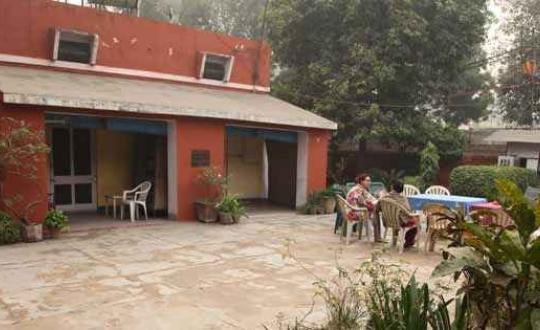
The main altar is for Thanh Mau, the Holy Mother, but rather than being placed on the altar, her statue sits on a throne in front. The reason for this unusual placing of the goddess is that she is honoring an uncut stone protruding from the cement floor, the stone itself covered with a red cloth decorated with floral and geometrical designs. Before the stone are incense sticks in a sand-filled bowl, a lamp, a vase, teapot and cups and a dish with an ancient coin used when querying the deity. Attached to a wall is a stele informing that the temple was rebuilt in 1951 by Tu Cung, the wife of King Khai Dinh (reigned 1916-25) and mother of King Bao Dai (reigned 1926-45; he died in exile in France in the summer of 1997). A side altar is dedicated to Holy Mother Thien Y A Na, a divinity of Hindu and Cham origins. The temple is called Thien Sinh Dien, Temple of the Newborn Goddess, and here is its story as recounted to me by the caretaker:

A farmer on his way to his peanut field hit a stone with the wheel of his cart. Slowly, then, the stone started to grow and after a number of years reached a height of over three feet. As it grew, it took the appearance of a woman with a necklace. To the villagers of Co Buu, such a wondrous stone was clearly very sacred, and because of its form, they associated it with the Holy Mother. A temple was built to protect and honor the stone. Prayers were offered to the stone and sometimes requests were addressed to it--perhaps a wish for a son, success on an examination or recovery from illness.

During the French war the Viet Minh burned down the temple, thinking the French were using it as a military outpost. (Another villager present during my visit said that it was in fact the French who set the temple aflame because they believed the Viet Minh were caching arms there.) The heat of the fire caused the stone to shatter. Later, the villagers took the fragments and buried them behind the temple. Today the grave is a circular mound of earth. There used to be a proper cement grave, but during the American war, it was blown up by a US shell together with the back of the temple.

Only the base of the stone statue now remains, under its red cloth and in front of the seated figure of the Holy Mother. Though the base is but a rough stone, the elderly caretaker said that it is now at least eight inches taller than his earliest memories of it, and perhaps in time, it will grow again into a woman with a necklace.

The small An Cuu River splits off from the Fragrant River near the Hue railway station and quietly flows through residential neighborhoods. Members of the royal family once lived behind the flame trees that line the riverbank and some of their cult houses still stand here. Sampans dock and children swim in the cool water. To the left is the house where once lived Tu Cung, the mother of Bao Dai, Vietnam's last king. The banks of the river now become noisier. From an early hour laborers mix sand, gravel and cement before pouring it into molds for bricks. Again on the left is Cung An Dinh, Khai Dinh's residence before he mounted the throne. An overhead bridge carries the national highway south to Danang. On the left is the new An Cuu market, but many sellers prefer to squat roadside, more convenient for motorbike riding shoppers.

After another few hundred yards, the river makes a sudden bend to the right. On the left, just where the force of the flowing water hits the bank, part of a large stone protrudes from atop the bank next to the entrance gate of the local people's committee offices. Children at play clamber on the stone and the wall behind. Neither the children nor the officials realize that on the stone are two faintly visible Chinese characters, not until a searcher of old Hue stops by and traces them out with his finger. The first character is Thach, "stone". Below it is a bit of Tran, "protect". And buried in the earth is surely Thuy, "water". Thach Tran Thuy, "stone which protects against water."

The land behind the stone, where the people's committee now sits, used to belong to an illustrious Hue family, the Nguyen Khoa. Long ago during the time of Lord Minh Vuong (ruled 1691-1725), the sons of this illustrious family had a long history of failing miserably each time they presented themselves at the mandarinate examinations. One day, Minh Vuong was passing here on his way to hunt when one of his closest advisors, the mandarin Nguyen Khoa Chiem (1659-1736), himself of another branch of the Nguyen Khoa clan, told the lord that the Nguyen Khoa sons regularly failed the examinations due to the waters of the An Cuu striking directly against the family lands, before flowing away to the right. Nefarious influences riding the river were unable to make the sharp turn and continued straight into the Nguyen Khoa compound, bringing misfortune with them. To block these harmful influences, the mandarin explained that a large stone should be placed as an obstacle at this precise spot right in front of their property. Were such a step taken, the next son of the family to sit for the examination would receive top marks. The counselor's advice was followed. His prediction came true and in the years thereafter, numerous sons excelled in the tests.

The Nguyen Khoa's stone is an obstacle stone meant to protect against harmful influences coming down the river. Other obstacle stones around Hue defend against evil descending a street, crossing a bridge or traversing a river on a ferry. These ambulant influences can cause calamities such as financial ruin, illness and even death. What form they take is unclear, but they are not ghosts, demons or evil spirits. Some personification has taken place; they follow roads and rivers, enter front gates just as human enemies would. By stopping their advance, the stone averts the misfortune they can bring.

The Nguyen Khoa's stone is not now venerated, nor was it when Father Cadiere wrote about it early in the century. It has magical protective qualities but it is not a spirit, luckily for those children who play on it.

This is the story that a student of mine told me about a boundary stone, having heard it first from her grandmother:

There was once an old village woman whose name was Bi. She sold "banh canh", a kind of thick soup of flat wheat noodles best eaten with a piece of trout. Every morning from the crack of dawn, Mrs. Bi would walk the village lanes calling out to all to start the day with a bowl of her nourishing fare. On her right shoulder was the carrying pole, from one end of which hung the heavy pot of steaming soup and from the other end, a basket with bowls, spoons, chopsticks and a rag to wipe them clean. One of her regular customers was a wealthy man who owned a great deal of land. Being in a good mood one morning while slurping his soup with some friends, he decided to tease old Mrs. Bi, saying that today he would not pay her for his potage. Instead, he issued a challenge. Pointing to a large, weighty stone, he said, "However far you can carry this stone, the land will belong to you," and he laughed confidently to his amused friends. One can imagine his surprise when frail old Mrs. Bi bent over and not only picked up the stone, but also began running with it and very quickly at that. The further she ran, the more worried the landowner became. Finally, he hastened after her, slowly catching up. Just when he was sure he would drop from exhaustion, he reached out and managed to get two fingers on the drawstring of Mrs. Bi's trousers.

With his last strength, he gave a tug; the string came loose and down fell Mrs. Bi's trousers. So ashamed was she that she immediately stopped running, dropped the stone and pulled up her trousers. The landowner was true to his word, perhaps fearing the raillery of the wealthy friends who had witnessed his dare, and to this day, Mrs. Bi's stone marks the boundary between the villages of An Lai and Van Quat Thuong.

A charming story, I thought, and then went out to check. Mrs. Bi's stone is indeed still there, in front of the local primary school, marking the territories of the two villages. A distinctive pale apricot in color and about half a yard long, the stone has a smoothness that suggests time spent on the bed of a pond or river. Set upright behind is a tall gray slab of rock, the usual boundary stone. No incense burns here, but next to Mrs. Bi's stone are the foundations of what must have been a shrine, for such a powerful stone would surely have engendered a cult. Perhaps the small shrine disappeared during the antisuperstitions campaign of the mid 1980s. Finally, I have often wondered whether the story of Mrs. Bi might not reflect a historical reality (or perhaps just a dream) of a victorious confrontation by ordinary villagers over great landowners, but I leave that question to scholars.

Of the twenty-two stones in Hue and its environs described by Father Cadiere, I managed to find eleven, some after long searches, and I looked in vain for another seven. In addition, I was able to learn the stories of stones such as the spirit stone and the boundary stone presented here. I have found yet other stones still worshiped by the villagers, but the reasons for their reverence have been forgotten, even by the village elders whom I asked. All they can say now is that the stones are very "linh" (sacred). I write then of the sacred and mysterious stones of Hue, of those whose stories have already been recorded by Father Cadiere and of others like the boundary stone of Mrs. Bi, lest they too slip beyond history.

Published on 5/1/98

Sponsor links

Comments [1]

stone ground

Contributor: cafengocmy [499] 7/3/05

0 of 0 people found this comment helpful.

All five stars from me.This is an excellent approach and illustrates much.I only passed one night in Hue, asleep on the Cathedral porch but I heard there was a stone on the grounds of some significance.

Was this comment helpful to you? Inappropriate

Add Comment

You might also be interested in

Mr. Pham Manh Ha with The chairman of the House’s Committe of Foreign Affaires of Vietnam

Award for Vietnam's First Luxury Tour Company & Full Travel Service Agency

Ha pham - lux4lux [714]

The Luxury Travel Company has received the prestigious Guide Awards 2008 for excellent performance in 2007 - 2008 with the appended remark: nothing is impossible, the fixer of problems. The ninth...

Destinations: Bangladesh | Malaysia | Tajikistan | Indonesia | Hong Kong | Georgia | Cambodia | Azerbaijan | Laos | Philippines | East Timor | Iraq | Turkmenistan | Turkey | Burma | Indochina | Tibet | Vietnam | Israel | India | Spratly Islands | Pearl River Delta | Taiwan | Iran | Qatar | Oman | Thailand | Afghanistan | Cyprus | United Arab Emirates | Korea, N | Mount Everest | Singapore | Brunei | Bahrain | Mekong River | Mongolia | Syria | Jordan | Armenia | Nepal | Kyrgyzstan | Pakistan | Macau | Kazakhstan | Yemen | Korea, S | Saudi Arabia | Kuwait | Maldives | Sri Lanka | China | Japan | Bhutan | Uzbekistan | Lebanon
Topics: Travel | Adoption | Literature | Women & Travel | Music | Art | People | Performing Arts | Sports | Shopping | War & Conflict | Ancient History | National Parks | Festivals | Martial Arts | Working Abroad | Agriculture | Architecture | Adventure | 20th Century History | Economy | Photography | Religion | Beaches & Resorts | Fashion | Animals | Traditions | Ecotourism | Culture | Food | Nature | For Kids
Website of Luxury Travel

the secret of the company code is lux4lux for discount. Do not Forget To Tell Your Friends!

Ha pham - lux4lux [714]

In a bid to enhance their customer interaction, Luxury Travel Company has launched its a travel blog, providing luxury trends, news, advice and travel stories across its Asian destinations.

Destinations: Bangladesh | Malaysia | Tajikistan | Indonesia | Hong Kong | Georgia | Cambodia | Azerbaijan | Laos | Philippines | East Timor | Iraq | Turkmenistan | Turkey | Burma | Indochina | Tibet | Vietnam | Israel | India | Spratly Islands | Pearl River Delta | Taiwan | Iran | Qatar | Oman | Thailand | Afghanistan | Cyprus | United Arab Emirates | Korea, N | Singapore | Brunei | Bahrain | Mekong River | Mongolia | Syria | Jordan | Armenia | Nepal | Kyrgyzstan | Pakistan | Macau | Kazakhstan | Yemen | Korea, S | Saudi Arabia | Kuwait | Maldives | Sri Lanka | China | Japan | Bhutan | Uzbekistan | Lebanon
Topics: Travel | Adoption | Literature | Women & Travel | Music | Art | People | Performing Arts | Sports | Shopping | War & Conflict | Ancient History | National Parks | Festivals | Martial Arts | Working Abroad | Agriculture | Architecture | Adventure | 20th Century History | Economy | Photography | Religion | Beaches & Resorts | Fashion | Animals | Traditions | Ecotourism | Culture | Food | Nature | For Kids
Farmer in Northern Vietnam - Copywrite Brenda Sunno

Do You Know How Vietnamese People Cultivate Wet Rice?

Ha pham - lux4lux [714]

It is not until you actually take off your shoes, roll up your trousers and muck in that you really appreciate the skill and energy required to harvest rice.

Destinations: Vietnam
Topics: Adoption | Travel | Adventure | Literature | Women & Travel | 20th Century History | Music | Art | Economy | Photography | People | Beaches & Resorts | Religion | Performing Arts | Fashion | Sports | War & Conflict | Shopping | Ancient History | National Parks | Festivals | Animals | Traditions | Ecotourism | Martial Arts | Culture | Food | Working Abroad | Agriculture | For Kids | Architecture
More Stories of Interest
ThingsAsian

ThingsAsian is an Asia travel website with maps, stories, photos and travel tips contributed by a worldwide community.

©1994-2008 Global Directions, Inc. All Rights Reserved. Contact webmaster@thingsasian.com

Web Development and Design by Dayspring Technologies, Inc.