Vietnam: Land of the Blue Dragon
Sampam laden with snake fruit at the floating market in Can Tho, the Capital of the West |
|
From its genesis in the low-lying valley of Lan Chang Jiang, the source of the great Blue River of southern China, the history of Vietnam is shrouded in a rich oral tradition of myth and legend. The Vietnamese believe themselves the descendants of a dragon and a goddess. The union of the dragon king Lac Long Quan and the enchanted mountain fairy Au Co produced a hundred beautiful giant offspring. Some went with their mother to inhabit the northern mountains. Others settled along the Red River, forming the Vietnamese kingdom of Van Lang in 2879 BC. The eldest son of the dragon king became the first sovereign of the Hung Dynasty, which lasted for a thousand years.
Vietnam has forged its identity out of a historic duality that continues into the present day. The northern nucleus, centered along the fertile Red River Delta, maintained close ties with China and was enriched by the flowering of the Dongsonian civilization. Owing to the South's strategic location at the junction of the sea routes between India and China, the southern island kingdoms such as Funan and Champa developed according to Indian traditions.
The Dongsonian civilization, the last and most developed of the Bronze Age cultures, was a marvel of cultural and artistic refinement.
From the Thai tribes, the Dongsons learned how to cultivate rice in irrigated paddies, an advanced technique for that period. They were the first to harness the devastating floodwaters of the Red River by building a system of dikes. Dongsonian art, which can also be found in other parts of Asia, has yet to reveal all its mysteries. The well-known bronze drum only hints at the artistic and intellectual sophistication of this essentially agrarian people. At its apogee, the Dongsonian civilization suffered irreparable cultural damage as a result of the new political order imposed by Chinese invaders.
In the third century BC, King An Duong Vulong, forerunner of the Tay ethnic group, established the first fortified capital at Co Loa in the ancient kingdom of Au Lac, not far from present-day Hanoi.
The kingdom of Funan flourished along the Mekong Delta between the first and sixth centuries AD. This highly developed civilization was strongly influenced by India.
The first capital, Vyadhapura (located in territory now belonging to Cambodia), and the port city of Oc Eo, south of Rach Gia, together played a vital economic role. They maintained Funan's commercial ties with the Gulf of Siam, Indonesia, Persia and the countries of the Mediterranean.
This brilliant civilization was absorbed by the pre-Khmer Chen La empire in the seventh century and disappeared.
The Hindu maritime kingdom of Champa radiated southward, covering the vast area between Vung Tau in the south, to the Deo Ngang Pass in the north.
Cham art, noted for its brick stupas and sculpture, reflects Indonesian influences and an Indian style that postdates the classic Indian Gupta period.
Today, the most impressive Cham ruins can be found in the former capitals and at the sacred site of My Son, a major destination for pilgrims. Shimapura, near Tra Kieu, was the first Cham capital. King Indravarman II (875-896) founded Indrapura near what is now Dong Dulong.
Champa attained its zenith during the reign of Indravarman III (918-958). The transfer of the political capital of Vijaya, near Binh Dinh, heralded the kingdom's decline. The last Cham king was killed by Hue warlords in 1692.
After a millennium of unbroken Chinese rule, and despite several celebrated but ultimately unsuccessful insurrections, the Vietnamese people experienced a national renaissance with the advent of the Ly Dynasty in the 11th century.
The capital of Thanh Long, now Ha Noi, was relocated on the right bank of the Red River in 1010. Chosen in accordance with the principles of geomancy, the new site was protected by the Blue Dragon and the White Tiger.
The Blue Dragon, ruler of the Orient, embodies the essential cosmic energy that protects the entire country and is the source of royal power. It symbolizes the entire nation and is identified with the water gods and the gods of fertility who invoke the rain. This divine association is characteristic of all the civilizations born of great rivers, from Mesopotamia to Korea.
While the dragon is responsible for the monsoon rains on which the harvest depends, it can also be a menacing presence, visiting storms and cataclysmic floods upon the land. To Confucian scholars, this mythic creature of supernatural powers represents strength, virtue and loyalty.
While the history of Vietnam is punctuated by conflict with the Chinese, their inevitable progression southward entirely assimilated the central Cham empire and the Khmer kingdoms of the Mekong Delta. During the course of this epic struggle, Vietnam fought against the imposing Celestial Empire of China and the armies of Genghis Khan.
Born out of this struggle, the concept of a uniquely Vietnamese identity only came into being in the 11th century, after Ly Thuong Kiet's stunning victory over the Chinese.
Throughout their long history, the Vietnamese people have been sustained by their deeply-held moral and spiritual values. Against a backdrop of animistic beliefs, they have drawn their inspiration from the great Asian philosophies of Buddhism, Taoism and Confucianism. This blending of religions is characteristic of China, Vietnam, Korea and Japan.
Confucianism formed the core of the country's former social structure. As political and spiritual leader, the sovereign ruled over the mandarins, the learned Confucian scholars obeyed the predominantly agricultural population. Often, however, the king's laws did not prevail over local village customs. From their Confucian heritage, the Vietnamese have learned to cherish the family bond, which is further strengthened by ancestor worship and a sense of filial duty.
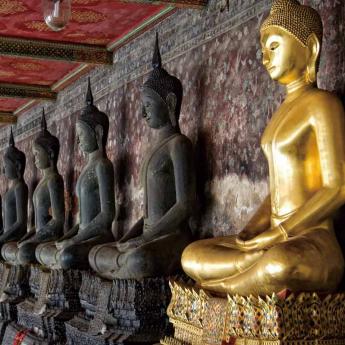
Buddhism was introduced to Vietnam from its country of origin by Indian monks and merchants during the second and third centuries BC. In the northern province of Ha Bac, Luy Lau became the first Buddhist centre in the country. It was founded by Indian monks who arrived from China in the second century AD. The monks Sonna and Uttara reached Vietnam by sea, crossing the Gulf of Siam, and spread Buddhism in the southern regions.
Originally, both Mahayana (also known as the Greater Vehicle) and Hinayana forms of Buddhism were practised, but by the seventh century, borrowing heavily from Chinese influences, the Mahayana form predominated. In central Vietnam, Buddhism, its ranks swelled by Chinese monks from the Funan region, spread from Hoi An and extended its influence all the way to the south. Other Chinese monks, travelling overland to the South, established many centres including Bien Hoa, Gia Dinh (Sai Gon) and My Tho.
A branch of the Cambodian Hinayana Buddhism was established in southern Vietnam in 1938. Cambodian doctor Ho Tong built the Buu Quang pagoda, the first Hinayana temple, in Thu Duc province.
In 1944, a third sect peculiar to southern Vietnam was founded by Minh Dang Quang. The beliefs of these itinerant monks incorporate the other two Hinayana sects. During the political upheavals in the period between 1954 and 1975, Mahayana Buddhism split into 20 branches.
Today the ruins of Dong Son, Funan, Champa and the former dynastic capitals remind us of the magnificent civilizations that once thrived in this land of water and rice fields. The ubiquitous paddy fields carpet the countryside and form the framework of village life. The Northern lifestyle reflects the harshness of the land and the devastating floods; the South is known for its gracious and generous nature.
Vietnam: Land of the Blue Dragon, is accompanied by a CD of original music played on traditional Vietnamese instruments.
Published on 10/1/96

[7 ratings]